Seed, Cutting or Young Plant: Three Ways to Begin
Seed, cutting or young plant: compare time, choice and hands-on care to choose a starting point that suits your garden and the season ahead.
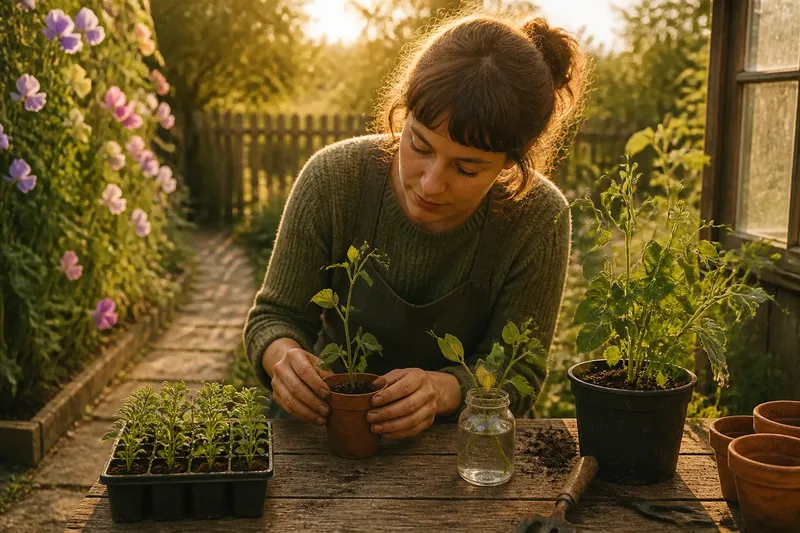
Should you start with seed, a cutting or a young plant? For a patch of sweet peas beside a kitchen path, each choice changes not just how long the flowers take to appear, but what you can choose, what you need to do and how closely you watch the plant as it settles in.
Imagine that Elsie, an invented gardener with a narrow bed and a sunny windowsill, wants sweet peas for the path. She has space for a small pot of seedlings indoors, a friend willing to share a cutting from a suitable plant, and a local nursery with young sweet peas for sale. Her aim is not to find one universally best route; it is to understand what each starting point asks of her.
Seed gives Elsie the widest choice and the longest beginning
Elsie could sow sweet pea seeds in small pots of seed compost. She would be choosing a plant at its earliest stage, with a broad choice of varieties in seed packets and the chance to raise several plants from one packet. That choice is useful if she has a particular colour or form in mind, or wants enough plants to fill a run along the path.
The trade-off is time spent before planting out. Seeds need suitable warmth, moisture and light to germinate and grow into sturdy seedlings. A crowded windowsill can become awkward, and young shoots need attention as they develop. If Elsie misses a watering or leaves seedlings in poor light, they may become weak before they reach the garden.
She would check the seed packet for sowing guidance and the expected growing conditions, then match those directions to her available indoor space. The seed route makes most sense when the pleasure of raising plants is part of the aim, and when there is room to care for them before they go outside.
Choose seed when variety and the process of raising several plants matter more than an instant start.
A cutting offers a direct link to a parent plant
Elsie’s friend might offer a cutting from a healthy sweet pea, but she first needs to check that the particular plant can be propagated this way. A cutting is a piece of a parent plant encouraged to form roots; it is not simply a small version of any plant that happens to be available. Some plants root readily from cuttings, while others are better raised by seed or bought as young plants.
When the plant is suitable, a cutting can preserve the characteristics of its parent. That can appeal to Elsie if she likes the colour or growth habit of a plant she has already seen. It also narrows her choice: she is starting with a particular plant, rather than browsing a broad range of varieties.
Rooting a cutting asks for close attention to moisture and conditions while roots form. Elsie would need a clean pot, an appropriate growing medium and a place out of harsh sun, then patience while the cutting establishes. It may fail to root, so relying on one cutting would leave her with no alternative if it shrivelled or rotted.
Before accepting the offer, she would ask whether the plant is suitable for propagation and follow sound guidance for that plant. If the exact method depends on a plant label, the supplier’s instructions or local rules, those directions take precedence.
A young plant brings the bed closer to flowering
At the nursery, Elsie could buy a young sweet pea already growing in a pot. This gives her a plant that has passed the earliest stage, so she can judge its shape and condition before taking it home. A nursery plant is often the quickest of the three routes to a visible presence in the bed, though it still needs to settle and grow.
Her choice may be narrower than it would be with seed, especially if she wants an unusual variety. The plant also costs more than raising one from seed in many situations, though prices vary and are not the only consideration: compost, pots and the space to raise seedlings have their own demands. A young plant suits someone who would rather spend less time tending early growth or who has missed the usual sowing window.
Elsie would look for healthy foliage and roots that do not appear badly congested, then check that the plant is suited to the bed and current conditions. She would water it as needed while it establishes and give it support if its growth habit calls for one. Buying a young plant reduces the early growing stage; it does not remove the need to care for it after planting.
Choose a young plant when a more immediate start matters and the available variety suits your plans.
How should Elsie choose between the three?
Which route gives the most choice?
Seed usually offers the broadest selection, particularly when a gardener wants a specific colour or a group of similar plants. A cutting keeps the choice close to a plant already admired, while a nursery’s stock determines which young plants are available.
Which route takes the least time before planting?
A young plant is generally closest to being ready for its place in the bed. Seedlings need time to germinate and grow, and cuttings need time to form roots; the actual pace depends on the plant and conditions.
Can a cutting replace seed for any plant?
No. Propagation from cuttings suits some plants and not others, so check the needs of the named plant before choosing this route. If it is unsuitable, seed or a young plant may be the more dependable option for that particular garden.
What if Elsie wants flowers soon but also enjoys raising plants?
She could buy one young plant for the bed and sow seeds for later, provided she has room to tend the seedlings. That mixes an early visible start with the slower pleasure of watching new plants develop, without making the whole plan depend on one batch.
One bed can show the difference between beginnings
Say Elsie decides to plant a nursery-grown sweet pea near the path, sow a few seeds in pots and take one suitable cutting from her friend’s plant. Her starting point is a bed that would otherwise remain empty and a small amount of indoor space; her action is to compare the routes on a modest scale rather than commit the whole bed to one. The observable result, as the plants develop, would be a clearer sense of which route suits her available time, preferred variety and appetite for tending young growth.
This is an invented situation, not a promise that every seed will germinate or every cutting will root. Elsie might find that one approach fits her routine while another becomes a pleasant extra. Keeping the plants identified with simple labels would help her notice which one began flowering first, which needed the most attention and which she enjoyed caring for.
Her choice also changes what she observes. Seed puts attention on emergence and the gradual formation of a plant. A cutting makes the development of roots the quiet first milestone. A young plant starts further along, so the gardener’s attention shifts sooner to how it adapts to its new place.
Match the starting point to the experience you want
For Elsie, seed is the option for choice and involvement from the outset; a cutting is the option for continuing a known plant where propagation is suitable; a young plant is the option for a head start with less early tending. None removes uncertainty, and none is automatically the right choice for every garden or season.
Consider what you want to notice as well as what you want to grow. If the pleasure lies in the first green shoots, make room for seed. If you are drawn to a particular parent plant, check whether a cutting is appropriate. If you want to concentrate on planting and settling a plant into its place, look for a healthy young one.
Seed, cutting or young plant is a choice about where your gardening begins, not just what goes into the soil. For a first attempt, choose the route that fits the plant, the season and the kind of attention you can comfortably give; then leave space to learn from what happens next.