The Garden Room Before the Garden Room
Garden room history helps you read old walls, hedges and gateways as clues to shelter, privacy and framed views, without mistaking interpretation for proof.
Why did gardeners enclose parts of a garden, and what can an old wall or clipped hedge tell you now? Garden room history is not one story with a single starting point: enclosed spaces served different purposes in different places and periods. A boundary may suggest shelter, cultivation, privacy or display, but its form alone cannot establish when it was built or why.
Enclosed gardens served practical needs
Long before the phrase “garden room” became familiar, people used boundaries to shape outdoor spaces. In medieval European monasteries, enclosed gardens included cloister garths and productive plots; walls and covered walks helped distinguish quiet, working spaces from the surrounding precinct. In other settings, enclosed yards and kitchen gardens helped keep animals out and make cultivation easier to organise.
These examples belong to particular traditions, not a universal sequence in which every garden gradually became more private. Materials, climate, ownership and local custom all affected the form an enclosure took. A stone wall, a hedge and a timber fence can each mark an edge, but they do not point to the same history.
When looking at a surviving boundary, separate what you can see from what you infer. Its position, material and openings are observable; its original purpose may remain uncertain unless other evidence survives.
Walls and hedges reveal how a space was used
A wall can provide a firm edge and shelter a plot; a hedge creates a living boundary that may also screen a seat or guide a path. In a productive garden, an enclosure might protect vegetables, herbs or fruit from animals. In a leisure garden, it could make a resting place feel distinct from a larger lawn or route.
Look for relationships rather than treating one feature as proof. A sunny wall beside a kitchen door may fit a working garden, while a secluded bench behind a hedge may suggest a place to pause. Either interpretation becomes stronger if paths, paving, gates or nearby buildings support it.
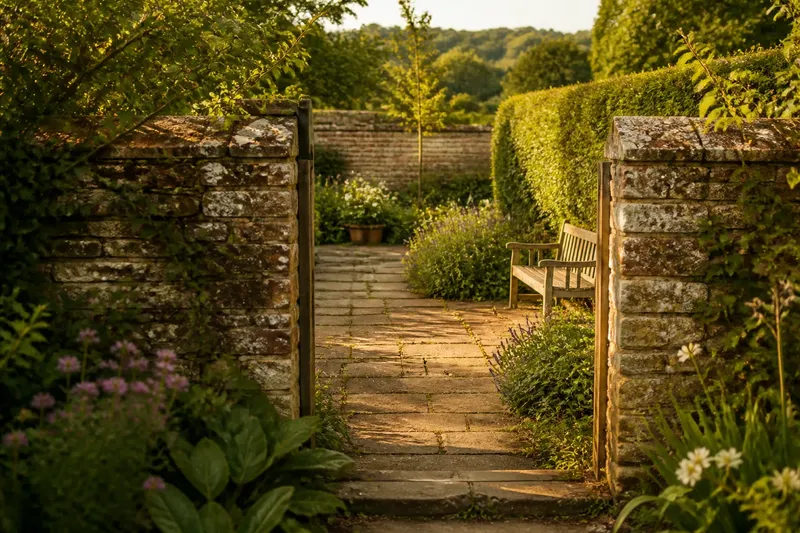
Notice whether the edge is continuous or interrupted. A narrow opening may control movement; a broad one may connect spaces or frame a view. The opening’s shape is clear evidence, but its original use is still an interpretation.
Stand on both sides, if access allows, and note what changes in light, wind, sound and visibility.
Privacy and display could share the same boundary
An enclosure did not always mean complete seclusion. A low wall could mark a garden’s edge while keeping a seated person connected to the view beyond it. A hedge might conceal a bench from a path but leave sightlines open from a house.
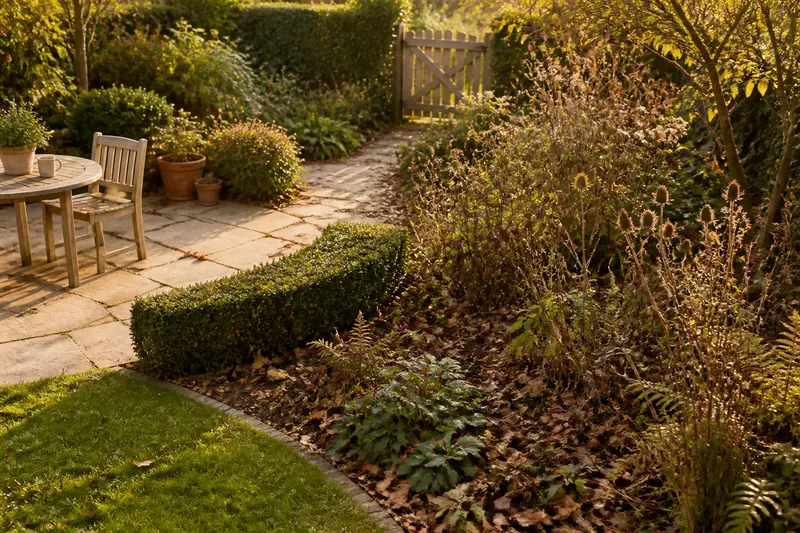
Imagine a garden with a low brick wall beside a path, a broad opening facing the house and a bench tucked into the sheltered corner. Those are invented details, not a historical case. The open entrance and protected seat would make a resting place easy to reach while offering some retreat; surviving paving or a doorway nearby could help assess whether that reading fits.
Look for who could see into the space, and from where. A boundary can protect a person from one direction while presenting the garden to someone approaching from another.
Openings framed views and directed movement
A gateway or gap can draw attention to a tree, statue, doorway or distant slope. The boundary limits competing views, so the opening may make a particular sightline feel deliberate. Yet a view that seems carefully framed today might have become so after paths or planting changed.
Look from the threshold as well as from the centre. A narrow entrance can reveal a feature gradually; a wide opening can show it at once. If the feature sits off-centre, consider whether an old path, seat or window might explain the alignment, but treat that as a possibility rather than a conclusion.
Compare the opening with the route through the space. A wall that bends around a path or stops beside a doorway may have responded to movement as much as to the view.
What clues help explain an enclosed garden?
Why might a garden wall be low?
A low wall can mark an edge without blocking light or conversation. Check its relationship to nearby seats, paths and windows before deciding whether it was intended to shape a view, guide movement or simply mark a boundary.
How can I tell whether a hedge was meant for privacy?
Notice its position, density and height relative to seating, paths and neighbouring buildings. A screen beside a resting place may suggest a desire for seclusion, but later growth or replacement planting can complicate that interpretation.
Did enclosed gardens always contain flowers?
No. Enclosed spaces could be used for vegetables, herbs, fruit trees, work or leisure as well as ornamental planting. A kitchen entrance, sunny wall or well-worn route may offer clues to practical use, but no single feature settles the question.
What should I notice at a garden entrance?
Observe whether the opening is narrow or broad, straight or angled, and what it reveals from the path. A turn may limit a direct view; an aligned opening may guide visitors towards a feature, though the arrangement could have changed over time.
Read surviving boundaries with care
Garden edges are often altered: a hedge may replace a wall, a doorway may be widened, or a path may shift. Before assigning a purpose, compare the boundary with steps, paving, drainage channels and nearby doors. Several clues pointing in the same direction make an interpretation more plausible, but they do not replace documentary or archaeological evidence.
Say you encounter a boundary with a gate, a strip of old paving and a sunny wall near a house. First, note those visible features without assigning a date. Then follow the paving to see whether it connects the gate to the house, and check whether the wall faces the sun and sits beside a likely service entrance. If the route and doorway align, access to a working plot is a plausible reading; if the paving instead leads towards a bench and a framed view, leisure use may fit better. Either way, record both possibilities rather than presenting a guess as fact.
- Check whether a wall’s stones, bricks or mortar visibly differ from adjoining sections; if they do, consider later repair or rebuilding, and compare other surviving sections before dating it.
- Check whether a hedge or wall blocks views from a path; if it does, consider screening as one possible purpose, and look for a seat or opening that might support a different use.
- Check where gates and gaps lead; if they align with a door or path, trace that route, but if they end at a changed or blocked area, leave the original destination uncertain.
- Check for paving, steps or worn ground beside the boundary; if these form a clear route, follow it to assess access, but if the route breaks off, avoid inferring where it once went.
- Check which way a sunny wall faces and what lies beside it; if it is close to a service entrance, consider a productive plot, but if it adjoins a sheltered seat, consider leisure use as well.
- Check whether an opening frames a tree, statue or distant feature; if the alignment is clear, note the viewpoint, but if planting or paths have changed, treat the framing as a present-day effect rather than proof of original design.
For a garden of your own, the history of enclosed spaces offers a useful design question: what should the boundary do? A woven screen might shelter a seating corner, while a low hedge could guide a view without shutting the garden away. Garden room history is clearest when you consider shelter, privacy and sightlines together, while keeping observation distinct from certainty.
Next time you pass through a gate, pause at the threshold and look back as well as ahead. The route, the view and the boundary’s surviving joins may help you distinguish what is still visible from what the garden’s past only invites you to imagine.