Why Repetition Gives a Garden Border Its Rhythm
Garden border repetition can link mixed planting without making it look uniform. Learn how to echo colour, shape and texture while keeping the border lively.
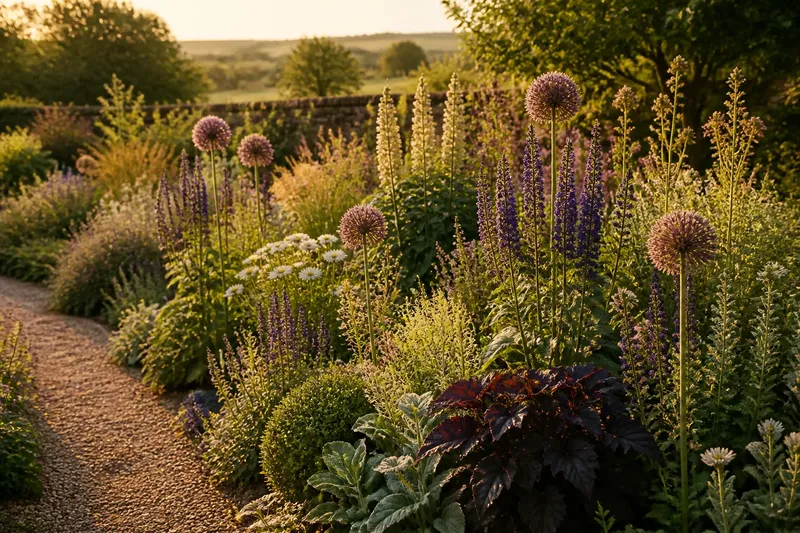
Why can a border full of lovely plants still look like a jumble? Garden border repetition gives the eye a route through mixed planting, while changes in height and texture keep that route from becoming monotonous.
The trick is to repeat a recognisable feature without copying every plant or group. Look first for what feels disconnected, then adjust one motif at a time.
Use repetition to link unrelated plants
When each plant seems to have been chosen for a different reason, the border may lack a visible link. A flower colour here, an unusual leaf there and a plant added simply to fill a gap can leave the eye with nowhere to travel.
Choose one feature already present and echo it elsewhere: a rounded flower head, a particular leaf outline, an upright shape or a colour. The repeated feature need not belong to the same species, but it should be easy to notice from the places where you usually view the border.
Say you have blue salvia in one corner, pale daisies in the centre and a dark-leaved plant by the path. Imagine adding another upright flower form farther along and a suitable pale-flowered plant near the far end. The expected result is two visual links—one through shape and another through colour—while the plant groups remain distinct.
Echo one feature in a distant part of the border before adding several new motifs.
Break up a repeated stripe
A repeated plant or colour can become a stripe when it forms an unbroken band. This is especially clear if plants of similar height make a straight edge along the front of the border.
Keep the connecting feature, but divide it into separate groups. Place a change of height, a contrasting leaf texture or a different outline between those groups, and avoid aligning every repeat along the same front-to-back line.
For instance, place one group nearer the path and another farther into the border, with a low mound between them. The eye can still pick out the recurring flower colour, while the changing outline gives the planting a more relaxed rhythm.
Vary the companions to avoid a predictable pattern
Equal clumps placed at matching intervals can make each section look like a copy of the last. Repetition is more interesting when one familiar feature returns among different neighbours.
Keep the motif consistent and vary its companions. A repeated colour might sit beside fine foliage in one group and broad leaves in another; a repeated upright form might rise from a low mound in one place and from looser, branching growth elsewhere.
View the border from the path and from a frequently used window. If the groups line up into a pattern you did not intend, shift one or change the plants around it.
Let a repeated colour have room to register
A colour chosen to connect the planting can take over if it appears everywhere at once. It may flatten the differences between sections or compete with flowers you want to stand out.
Reduce the number of places where that colour appears, or vary its role. It might occur in flowers in one area and as a quieter foliage note elsewhere. A patch of contrasting texture or flower shape can also give the repeated colour a pause before it returns.
Look at the border when the chosen flowers are most visible. If their colour reads as one uninterrupted block, use a distinct foliage patch or another flower shape to create a visual break.
Make the repeated feature visible from your usual viewpoint
A motif cannot connect the border if it disappears into surrounding plants. Fine foliage may be clear close up but hard to distinguish from a path, while a flower can blend into a mass of similar colours or be hidden by taller growth.
Decide what should carry the repeat, then check it from the path, a seat or a window. If the flower colour vanishes, use the plant’s outline or foliage instead; if the silhouette is obscured, choose a more legible form or give the groups more breathing room.
Consider when the feature is visible. A recognisable leaf shape may link the border after flowers fade, while repeated blooms can provide a stronger seasonal echo during their display.
How can you adjust garden border repetition?
Should you repeat the same plant or just its colour?
Either approach can work. Repeating one plant creates a clear motif; echoing its colour, outline or texture allows greater variety in the plants around it.
How many features should you repeat?
Begin with one strong feature and view the border from your usual vantage point. Add a second only if the planting still feels disconnected; if the motifs compete, keep the clearer one and let the other go.
Where should repeated groups go?
Place groups where they can be seen from a path, seat or regularly used window, and avoid putting every one in a straight line. If a group is hidden, move it or choose a more visible companion plant.
What if the border changes through the seasons?
Use a leaf shape or plant outline as a longer-running link, then let flower colour add a seasonal echo. If the border is newly planted, observe how its shapes emerge before making several changes at once.
Keep the rhythm visible as the seasons change
Flowers, seed heads, leaves and bare outlines take turns becoming the most noticeable features. A border linked by a brief flowering display may feel less joined up once those blooms finish.
Notice which shapes and textures remain visible as the planting changes. You might repeat a foliage form in separate sections while letting flower colours vary, or accept that the strongest rhythm belongs to one particular season.
Garden border repetition works best when a familiar feature returns beside a different neighbour. Make one adjustment, then look again from the places you use; that small pause helps you see whether the motif connects the border or simply adds another stripe.